Skip to content


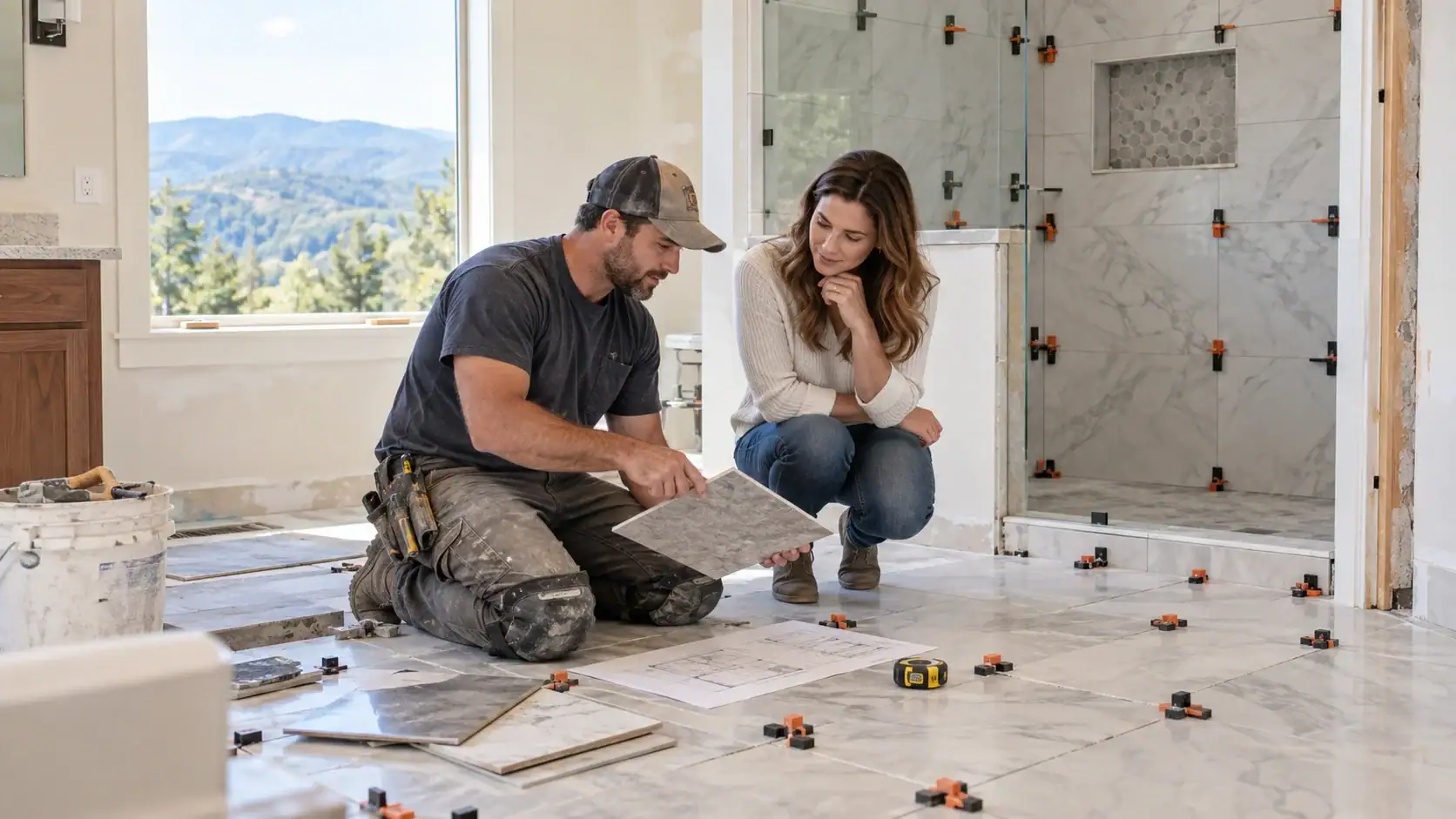
You can spend weeks choosing the perfect porcelain tile, grout color, shower niche, and layout. But once installation starts, the quality of the finished project depends heavily on the person putting those materials together.
A good installer does more than make straight grout lines. They evaluate the substrate, plan cuts before setting the first tile, use the correct waterproofing and setting materials, account for tile warpage, and build the installation so it performs long after the renovation photos are taken.
That matters whether you are remodeling a bathroom in Gainesville, replacing flooring near Lake Lanier, building a shower in Calhoun, or shopping for tile near Adairsville.
If you are searching for tile installation contractors near me or comparing North Georgia flooring installers, these five questions can tell you much more than simply asking, “How much do you charge per square foot?”
Why a Good Tile Contractor Matters Just as Much as Good Materials
Porcelain tile can be exceptionally durable, but even premium material cannot compensate for a poor installation.
Problems caused by improper installation can include:
- Excessive lippage between neighboring tiles
- Cracked tile or grout
- Loose or hollow-sounding tiles
- Poorly balanced cuts around walls and fixtures
- Crooked grout joints
- Water intrusion behind a shower installation
- Poor drainage or standing water
- Visible layout mistakes that cannot be corrected without removing tile
Many of these problems are expensive to fix because tile is a finished surface. Correcting what is underneath it often means taking the finished work back apart.
This is particularly important with modern materials such as large-format porcelain. A 12×24 tile leaves less room to hide an uneven wall or floor than a small mosaic does.
If you want a better understanding of what goes into a proper tile installation before interviewing contractors, Tile Factory Direct’s porcelain tile installation guide covers surface preparation, layout, mortar, spacing, cutting, and grouting.
Question 1: What Waterproofing System Do You Use for Showers?
If your project includes a tiled shower, this should be one of the first questions you ask.
Tile and grout are not, by themselves, a complete waterproofing system.
Water can pass through grout joints and other parts of a tiled assembly, which is why modern showers need a properly designed water-management system behind or directly beneath the tile.
Ask the installer what waterproofing system they normally use and why.
A knowledgeable answer might include:
- Sheet-applied waterproofing membranes
- Liquid-applied waterproofing membranes
- Foam shower-board systems
- Bonded waterproof shower systems
- Traditional mortar-bed assemblies constructed according to an approved method
What you want to hear is a complete system—not simply, “The tile and grout keep the water out.”
For example, Schluter’s shower-system guidance specifically notes that tile itself is not inherently waterproof and should be installed with a waterproofing system that manages moisture and protects moisture-sensitive materials.
Ask Them to Describe the Whole Shower Assembly
You do not have to become a tile installer yourself, but the contractor should be able to explain the system in plain language.
Ask:
- What is behind the tile?
- How are corners and seams waterproofed?
- How is the shower pan constructed?
- How is the drain integrated into the waterproofing?
- How are niches and benches handled?
- Is the shower flood-tested before tile is installed when appropriate?
A contractor who builds showers regularly should be comfortable explaining these details.
Be cautious if the entire waterproofing explanation consists of moisture-resistant drywall, tile, grout, and caulk with no actual waterproofing assembly identified.
Question 2: What Licensing, Insurance, and Industry Standards Apply to My Project?
You will often hear advice telling homeowners to hire only a “licensed tile contractor.” In Georgia, the situation is more nuanced.
The Georgia Secretary of State identifies ceramics and hard tile as a traditional specialty contracting category. Specialty contractors working within the defined scope of their specialty may not be required to hold the same residential or general contractor license required for broader contracting work.
That means the better question is not simply, “Do you have a contractor’s license?”
Ask:
- What license, if any, applies to the scope of this project?
- Do you carry general liability insurance?
- Do you carry workers’ compensation coverage when required?
- Who is responsible for permits if the project requires them?
- Will plumbing, electrical, or structural work be performed by appropriately qualified trades?
A tile-only backsplash and a complete bathroom remodel involving plumbing, framing, electrical work, and structural changes are not the same scope of work.
Ask Whether They Follow Recognized Tile Industry Standards
Beyond legal licensing requirements, you want someone who understands established installation methods.
Ask whether the installer is familiar with the TCNA Handbook and applicable ANSI tile-installation standards.
The Tile Council of North America publishes installation methods used throughout the industry for showers, floors, walls, movement joints, substrates, and many other tile assemblies.
Professional involvement can also be a useful signal. The National Tile Contractors Association provides education, technical resources, training, and contractor directories for the tile industry.
You can also look for installers who have earned the Certified Tile Installer designation through the Ceramic Tile Education Foundation. The CTEF Certified Tile Installer directory allows homeowners to search for installers who have completed an independent assessment of tile-installation knowledge and hands-on skills.
No membership, certification, or license guarantees that every project will be perfect. References, experience, insurance, project scope, and workmanship still matter. But a contractor who invests in recognized industry education gives you another useful data point when comparing bids.
Question 3: How Do You Handle Large-Format Tile and 12×24 Layouts?
If your project involves 12×24 porcelain, long wood-look planks, or even larger tile, do not assume the installation process is simply standard tile work with bigger pieces.
Large-format tile places much greater demands on substrate flatness and layout planning.
Ask the installer:
- How do you check the floor or wall for flatness before setting tile?
- How do you correct high and low areas?
- How do you check the tile itself for warpage?
- How do you determine the appropriate trowel and mortar coverage?
- Do you back-trowel larger tiles when needed?
- How do you control lippage between adjacent pieces?
- Do you use a tile-leveling system when appropriate?
Why the Popular 50% Brick Pattern Can Be a Problem
One of the most useful questions you can ask is how the installer plans to offset rectangular tile.
Large rectangular porcelain tiles can contain a small amount of allowable warpage. Often, the center of a long tile is slightly higher than its ends.
With a traditional 50% brick pattern, the center of one tile lines up with the ends of the neighboring tiles. That can place the highest and lowest portions beside one another and exaggerate lippage.
For rectangular tiles where the side being offset is longer than 15 inches, industry guidance generally calls for an offset of no more than approximately 33% unless the tile manufacturer permits something different or a larger-offset installation is evaluated and accepted.
Florida Tile’s installation guidance, for example, explains the TCNA recommendation for a maximum 33% offset on larger rectangular tiles and why a 50% offset can make tile warpage more visible.
The exact tile manufacturer’s recommendations should always win. Some products can tolerate different layouts; others may specify even less offset.
Leveling Clips Help, but They Are Not a Substitute for Preparation
Tile-leveling clips and wedges can be useful for keeping adjacent tile edges aligned while mortar cures.
But simply seeing a bucket of leveling clips does not prove that an installer understands large-format tile.
A leveling system cannot turn an improperly prepared floor into a flat one. It also cannot correct excessive tile warpage, poor mortar coverage, or a badly planned layout.
The strongest answer is one that starts with substrate preparation and layout, not the brand of clips the contractor uses.
Question 4: Can I Choose and Purchase My Tile Separately?
There are two common ways contractors handle materials.
Some provide one complete quote that includes both labor and material allowances. Others allow homeowners to purchase the finished tile themselves while the installer supplies or specifies setting materials.
Neither arrangement is automatically better, but you should understand which one you are getting.
If your contractor includes a “tile allowance” of a certain amount per square foot, ask:
- Which products actually fit within that allowance?
- Does it include sales tax and delivery?
- Does it include grout, mortar, trim, waterproofing, and underlayment?
- What happens if you choose tile above the allowance?
- Who calculates waste and overage?
- Who is responsible if additional tile is needed later?
Buying Your Tile Yourself Can Give You More Control
For many North Georgia homeowners, choosing the finished tile directly from a local showroom can simplify this part of the project.
You can see the actual color, finish, scale, texture, and variation before making a decision rather than choosing from a small contractor sample or online photo.
Tile Factory Direct has locations in both Gainesville and Adairsville, giving homeowners in Northeast and Northwest Georgia the ability to shop tile and installation materials locally.
The Gainesville showroom opened in 2025 with tile, adhesives, grout, tools, design counters, and installation materials from brands including Schluter, Custom Building Products, and ARDEX. You can read more in Tile Factory Direct Opens New Store in Gainesville, GA.
The Adairsville location includes a much larger warehouse and showroom serving Northwest Georgia. It was also recognized as Best Tile Selection & Showroom in Northwest Georgia for 2025; see Best Tile Selection & Showroom 2025 – Tile Factory Direct for more information.
Choosing the material yourself also makes it easier to know exactly what you are paying for. Your contractor can then focus the labor quote on preparation, waterproofing, setting, cutting, grouting, and finishing.
Have the Installer Approve the Material Before You Order
Do not order thousands of dollars of tile without confirming that your installer is comfortable working with it.
A good contractor may identify concerns you have not considered, such as:
- A polished floor tile in a wet location
- An unusual thickness that affects transitions
- A large-format tile requiring extra wall preparation
- A mosaic with difficult sheet alignment
- A natural stone product that requires sealing
- A trim or edge detail that needs to be ordered separately
Bring the product name or technical sheet to the installer before the order is finalized.
Question 5: Can I See Recent Work, References, and a Written Scope?
Photos are helpful. Recent local references are better.
Ask to see completed work that resembles your project.
If you are hiring someone for a curbless shower with 24×48 porcelain tile, photos of subway-tile backsplashes do not tell you much about their ability to execute your project.
Ask specifically for:
- Recent shower projects if you are building a shower
- Large-format installations if you selected large tile
- Flooring installations if your project is a large open area
- Projects completed several years ago when possible
- Local references you can actually contact
A project that still looks good three years later tells you something a brand-new Instagram photo cannot.
Get the Scope in Writing
A detailed quote should explain more than the total price.
Before signing, make sure you understand who is responsible for:
- Demolition
- Disposal of old material
- Subfloor or wall preparation
- Floor flattening or leveling
- Waterproofing
- Setting materials
- Grout
- Tile trim
- Movement and change-of-plane joints
- Plumbing fixture removal or installation
- Material pickup or delivery
- Cleaning after installation
- Repairing unexpected substrate damage
Ask how change orders are handled as well.
If demolition reveals water damage or an unsuitable subfloor, you want to know how additional work will be priced before the contractor is halfway through the room.
Ask About the Labor Warranty
Find out what the installer warrants and for how long.
Also ask what is excluded.
A labor warranty may cover certain installation failures but not damage caused by structural movement, plumbing leaks, homeowner abuse, product defects, or work performed later by another trade.
Getting those expectations in writing helps both parties.
Where Can I Find Tile Installers Near Gainesville or Adairsville?
If you already have your tile selected but still need an installer, Tile Factory Direct maintains a North Georgia tile and LVP installer directory with service-area filters for Gainesville, Adairsville, Calhoun, Cartersville, Braselton, Cumming, and surrounding areas.
Homeowners searching specifically around Hall County can use the Gainesville tile installer directory, while Northwest Georgia homeowners can browse tile installers serving Adairsville.
These installers are independent professionals. Tile Factory Direct supplies flooring materials and does not employ, oversee, or warranty the labor of contractors listed in the directory.
Use the directory as a starting point, then perform the same due diligence you would with any contractor: verify current insurance, check references, review comparable projects, confirm the scope, and get the agreement in writing.
Red Flags When Interviewing a Tile Installer
Price alone should not determine who gets the job.
Be cautious if a contractor:
- Cannot explain how a tiled shower is waterproofed
- Says tile and grout alone make a shower waterproof
- Dismisses substrate preparation as unnecessary
- Plans to install large tile over an obviously uneven surface without correction
- Cannot explain how they achieve proper mortar coverage
- Automatically uses a 50% offset on every 12×24 or plank tile regardless of manufacturer guidance
- Refuses to provide proof of insurance when applicable
- Will not provide recent references
- Provides a vague one-line quote for a complicated project
- Cannot tell you which installation materials they intend to use
- Requires a very large upfront payment without a clear written contract or material explanation
None of these questions require the installer to give you an hour-long technical presentation.
The point is whether they can explain their process confidently and clearly.
Should You Hire the Cheapest Tile Contractor?
Probably not based on price alone.
Two contractors can quote the same 100-square-foot bathroom while planning very different amounts of work.
One bid may include flattening the substrate, a complete waterproofing system, premium mortar, movement joints, careful layout, and detailed finishing.
Another may assume the existing surface is good enough and begin setting tile immediately.
The second bid can look much cheaper because you are not actually comparing the same installation.
When comparing estimates, compare the scope before comparing the bottom line.
A properly installed $4-per-square-foot tile can outperform a poorly installed $12-per-square-foot tile. Material quality matters, but installation determines whether that material gets a fair chance to perform.
Shopping for Gainesville Flooring? Choose the Material Before the Installer Starts
If you are still in the planning stage, choosing your finished materials before construction begins can make contractor quotes more accurate.
Knowing whether you are using a 12×24 porcelain tile, a 2-inch shower mosaic, natural stone, or a large-format panel changes the labor and preparation required.
Homeowners looking for flooring in Gainesville, GA can visit the Tile Factory Direct Gainesville showroom at 1002 Chestnut Street SE, just off I-985.
Those closer to Bartow, Gordon, or Northwest Georgia can visit the Adairsville tile showroom at 511 Soho Drive.
You can also browse Tile Factory Direct’s tile selection online before visiting a showroom.
Once you narrow down the material, show the exact selection to potential installers. That gives them an opportunity to evaluate the tile size, finish, pattern, trim requirements, and installation method before they price the job.
The Bottom Line: Hire for the Installation You Are Actually Building
The best tile installer for a simple backsplash is not automatically the best contractor for a custom waterproof shower or a large-format porcelain floor.
Match the installer to the project.
Ask how they waterproof showers. Ask how they follow recognized tile-industry standards. Ask how they prepare substrates and control lippage with large-format tile. Understand who is buying the materials. And always ask for comparable work, references, insurance information, and a clear written scope before work begins.
If you are still looking for a place to start, browse Tile Factory Direct’s North Georgia installer directory, then independently verify the contractor who best fits your project.
And before installation day arrives, visit our Gainesville or Adairsville showroom to compare tile in person, confirm quantities and trim pieces, and make sure the material going into your home is exactly what you expected.
A beautiful tile project starts with good material. A lasting one requires good installation too.